Back to journal
Nearshore8 min readJuly 13, 2026

Outsourcing Software Development: Red Flags That Predict a Bad Project Before It Starts

A practical guide for founders and CTOs on spotting outsourcing software development red flags before a project turns expensive, slow, or hard to recover.

#outsourcing software development red flags#nearshore software development#software outsourcing#CTO hiring#software delivery
Outsourcing Software Development: Red Flags That Predict a Bad Project Before It Starts

# Outsourcing Software Development: Red Flags That Predict a Bad Project Before It Starts

Short answer: the biggest outsourcing software development red flags appear before the first sprint starts. If a vendor cannot explain scope boundaries, deployment ownership, QA strategy, communication rhythm, and maintenance responsibility in concrete terms, the project is already carrying delivery risk.

Bad outsourcing rarely fails because one developer writes weak code on week six. It usually fails because the working model was vague from the beginning. Everyone was polite. The proposal looked reasonable. The kickoff felt positive. But nobody had a shared definition of done, release ownership, quality gates, escalation paths, or post-launch accountability.

For founders, CTOs, and technical buyers, the goal is not to avoid every unknown. Software projects always contain uncertainty. The goal is to identify whether the outsourcing partner has a disciplined way to surface, manage, and reduce that uncertainty.

Below are the red flags that predict a bad project before it starts, plus practical ways to test for them during vendor evaluation.

1. The Scope Sounds Confident but Not Specific

A vendor who says “yes” too quickly is often transferring risk back to you.

Early confidence is useful only when it is backed by assumptions, tradeoffs, and constraints. If the vendor accepts a broad product idea and immediately commits to timeline and price without asking hard questions, they are probably estimating the shape of the sales conversation, not the work.

Watch for vague phrases like:

  • “That should be straightforward.”
  • “We can handle everything.”
  • “The team will figure that out during development.”
  • “We have done similar projects many times.”

None of those statements are automatically wrong. The problem is when they replace discovery.

A serious software partner should ask about users, workflows, integrations, environments, data ownership, compliance constraints, operational handoff, and what happens if priorities change. They should separate known requirements from assumptions. They should also tell you where the estimate is weak.

A stronger answer sounds more like this:

> “We can estimate the first release, but the integration with your billing system is still unclear. We would treat that as a discovery item in week one and avoid committing to a fixed release date until we inspect the API and test environment.”

That kind of answer is less flashy, but it is more useful.

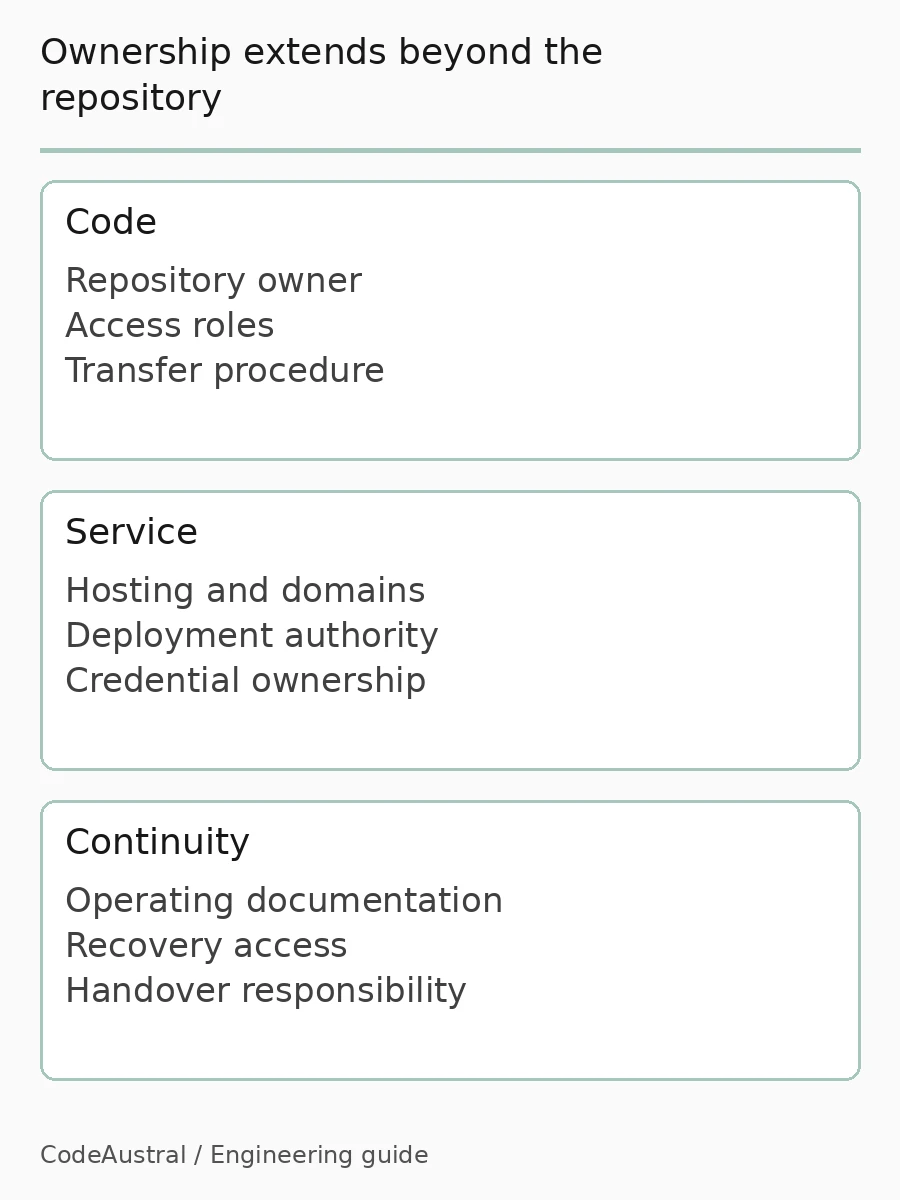
2. Nobody Owns Deployment

Deployment ownership is one of the clearest predictors of project health.

A team can build features, pass demos, and still leave you with software that is painful to release. If deployment is treated as someone else’s problem, the project will accumulate hidden risk until launch week.

Before signing, ask:

  • Who owns CI/CD setup?
  • Who manages environment configuration?
  • Who creates deployment documentation?
  • Who has access to cloud accounts, secrets, and release pipelines?
  • Who is responsible when a release fails?
  • How will rollback be handled?

If the vendor says, “Your team usually handles that,” clarify whether they are still accountable for making the application deployable. A codebase is not done because it runs on a developer laptop.

For early-stage companies, this matters even more. You may not have a platform team. You may not have mature infrastructure. A good outsourcing partner should either provide deployment capability or define exactly what they need from your side.

A practical example: if the project includes a web application, API, database, background jobs, and third-party integrations, the delivery plan should include environments for local development, staging, and production. It should also include how migrations are run, how secrets are managed, and how releases are verified.

If none of that appears in the proposal, you are not looking at a complete delivery plan.

3. QA Is Described as “Testing Before Delivery”

QA cannot be a final cleanup step.

When a vendor treats quality assurance as something that happens after development, you should expect late defects, unclear acceptance criteria, and avoidable rework. Testing at the end only tells you how much risk has accumulated. It does not prevent the accumulation.

A credible QA plan should explain what gets tested, when it gets tested, who tests it, and how defects are handled.

Red flagBetter signal
“Developers test their own work” with no further detailUnit, integration, and manual acceptance testing are defined by feature type
QA starts near the release dateQA participates from sprint planning or story refinement
No acceptance criteriaEach feature has expected behavior, edge cases, and failure states
No regression planCritical flows are identified and retested before release
Bugs are handled informally in chatDefects are tracked, prioritized, assigned, and verified

You do not need a heavyweight testing bureaucracy for every project. A lean MVP may not need the same test coverage as a financial workflow or healthcare platform. But the team should be able to explain the quality bar in context.

Ask for examples:

  • “For a payment flow, what would you test before release?”
  • “How do you decide what needs automated coverage?”
  • “What happens when QA rejects a story?”
  • “Who approves that a feature is ready for production?”

If the answers are generic, the QA process probably is too.

4. There Is No Communication Rhythm

Outsourcing does not fail because teams are remote. It fails when the operating cadence is weak.

A communication rhythm is not just “we use Slack.” It is the structure that keeps decisions, progress, blockers, and expectations visible.

For a serious engagement, you should know:

  • When planning happens
  • When demos happen
  • When status updates are sent
  • How blockers are escalated
  • Who attends which meetings
  • Where decisions are recorded
  • How time zone overlap is used

This is especially important in nearshore software development, where time zone alignment can be a major advantage if used well. A nearshore team in Latin America can often work with U.S. companies in real time, but proximity alone does not create clarity. The team still needs habits.

If you are comparing models, this guide on nearshore software development in Argentina for U.S. companies gives useful context on why overlap, collaboration, and team integration matter.

A weak vendor sends updates when asked. A strong vendor creates a delivery cadence that reduces the need to ask.

A practical weekly rhythm might look like this:

  • Monday: sprint planning or priority review
  • Tuesday to Thursday: async progress updates plus focused working sessions
  • Wednesday: blocker review for product, technical, or access issues
  • Friday: demo, delivery notes, risks, and next-week priorities

The exact schedule can vary. The important part is that communication is intentional, predictable, and tied to delivery.

5. The Team Cannot Explain the Maintenance Model

The project does not end at launch.

Many outsourcing problems appear after the first release, when the original team has moved on, no one owns incidents, and the buyer discovers that small changes are expensive because the system was not built for handoff.

Maintenance should be discussed before development starts.

Ask:

  • Who fixes production bugs after launch?
  • What response expectations apply after release?
  • Is there a warranty period for defects?
  • Who monitors errors and uptime?
  • How is technical debt tracked?
  • What documentation will be delivered?
  • Can another team take over the codebase?

Avoid vendors who frame maintenance as an optional afterthought. Even if you do not buy a long-term support contract, you need a clean handoff model.

That includes repository access, environment documentation, deployment instructions, dependency notes, known limitations, and a backlog of deferred improvements. If the vendor cannot explain how they leave the system maintainable, they are probably optimizing for project closure rather than long-term ownership.

6. The Proposal Hides the Real Team

You should know who will actually do the work.

A polished sales process can mask a weak delivery team. Before committing, clarify the people involved, their roles, their availability, and whether they are dedicated or shared across multiple clients.

This does not mean every person must be full-time. Part-time architecture, DevOps, QA, or product support can be reasonable depending on the project. But the staffing model should be explicit.

Red flags include:

  • No named delivery lead before kickoff
  • Senior people present in sales but absent from delivery
  • No clear product or technical owner
  • Developers assigned only after contract signature
  • Heavy reliance on “bench strength” without specific allocation

Ask who will make technical decisions. Ask who reviews pull requests. Ask who talks to your internal team. Ask what happens if a key person leaves.

You are not buying abstract capacity. You are trusting a team with product execution.

7. They Avoid Tradeoffs

Every software project has tradeoffs. Speed, cost, scope, quality, maintainability, and flexibility cannot all be maximized at once.

A vendor who refuses to discuss tradeoffs is either inexperienced or selling certainty they do not have.

For example, if you ask for a complex MVP in eight weeks, a credible partner should help you separate launch-critical workflows from later enhancements. They may suggest cutting administrative features, simplifying permissions, delaying a nonessential integration, or using a managed service instead of custom infrastructure.

That is not resistance. That is engineering judgment.

A useful vendor will say things like:

  • “This can be done quickly if we accept manual operations for the first release.”
  • “This feature is risky because it depends on a third-party API we have not inspected.”
  • “We can build this custom, but a managed service may be better until usage patterns are clearer.”
  • “If maintainability matters, we should not compress this part of the schedule.”

If every answer is yes, the real no may arrive later as missed deadlines, quality issues, or change orders.

8. There Is No Clear Definition of Done

“Done” must mean more than “the developer finished coding.”

A useful definition of done might include:

  • Code is implemented and reviewed
  • Acceptance criteria are met
  • Tests are added or updated where appropriate
  • QA has verified the feature
  • Product owner has accepted the behavior
  • Documentation is updated if needed
  • The feature is deployed to staging
  • Any known limitations are recorded

Without this shared standard, every delivery conversation becomes negotiable. The vendor says a feature is complete. Your team says it is not usable. Both sides lose time arguing because the project never defined completion clearly.

This is a simple thing to ask during evaluation:

“What does done mean for a user-facing feature?”

If the answer does not include review, testing, acceptance, and deployment context, tighten the process before work begins.

9. Pricing Is Clear but Change Control Is Not

A fixed price can still hide major uncertainty. A time-and-materials model can still be disciplined. The pricing model matters less than how change is handled.

Before starting, clarify:

  • What counts as a scope change?
  • How are new requests estimated?
  • Who approves additional work?
  • How are tradeoffs handled when priorities shift?
  • How are budget risks surfaced?
  • What happens when assumptions prove wrong?

A weak process treats change as friction. A strong process treats change as expected but controlled.

For example, if user testing shows that onboarding needs to change, the team should be able to estimate the impact, present options, and update the plan. They should not quietly absorb the work until the schedule breaks, or immediately turn every adjustment into a commercial dispute.

Pre-Contract Checklist

Use this checklist before committing to an outsourcing partner:

  • [ ] Scope includes assumptions, exclusions, and unresolved questions
  • [ ] Delivery plan identifies milestones and acceptance criteria
  • [ ] Deployment ownership is explicit
  • [ ] QA process is defined before development starts
  • [ ] Communication cadence is agreed in writing
  • [ ] The actual delivery team and roles are visible
  • [ ] Technical leadership is assigned
  • [ ] Change control process is clear
  • [ ] Maintenance and handoff model are documented
  • [ ] Repository, environment, and access expectations are defined
  • [ ] Security and data access responsibilities are understood
  • [ ] The vendor can explain tradeoffs, not just promises

If several of these are missing, slow down. You may not need a different vendor, but you do need a clearer working model before signing.

How to Test a Vendor Before You Commit

The best way to evaluate an outsourcing partner is to ask operational questions, not just capability questions.

Instead of asking, “Can you build this?” ask:

  • “What would you need to know before estimating this responsibly?”
  • “Which part of this project looks riskiest?”
  • “What would you cut from version one if the deadline could not move?”
  • “How would you structure the first two weeks?”
  • “What would you need from our internal team?”
  • “How would we know every Friday whether the project is healthy?”

Strong teams answer these questions with specifics. Weak teams stay abstract.

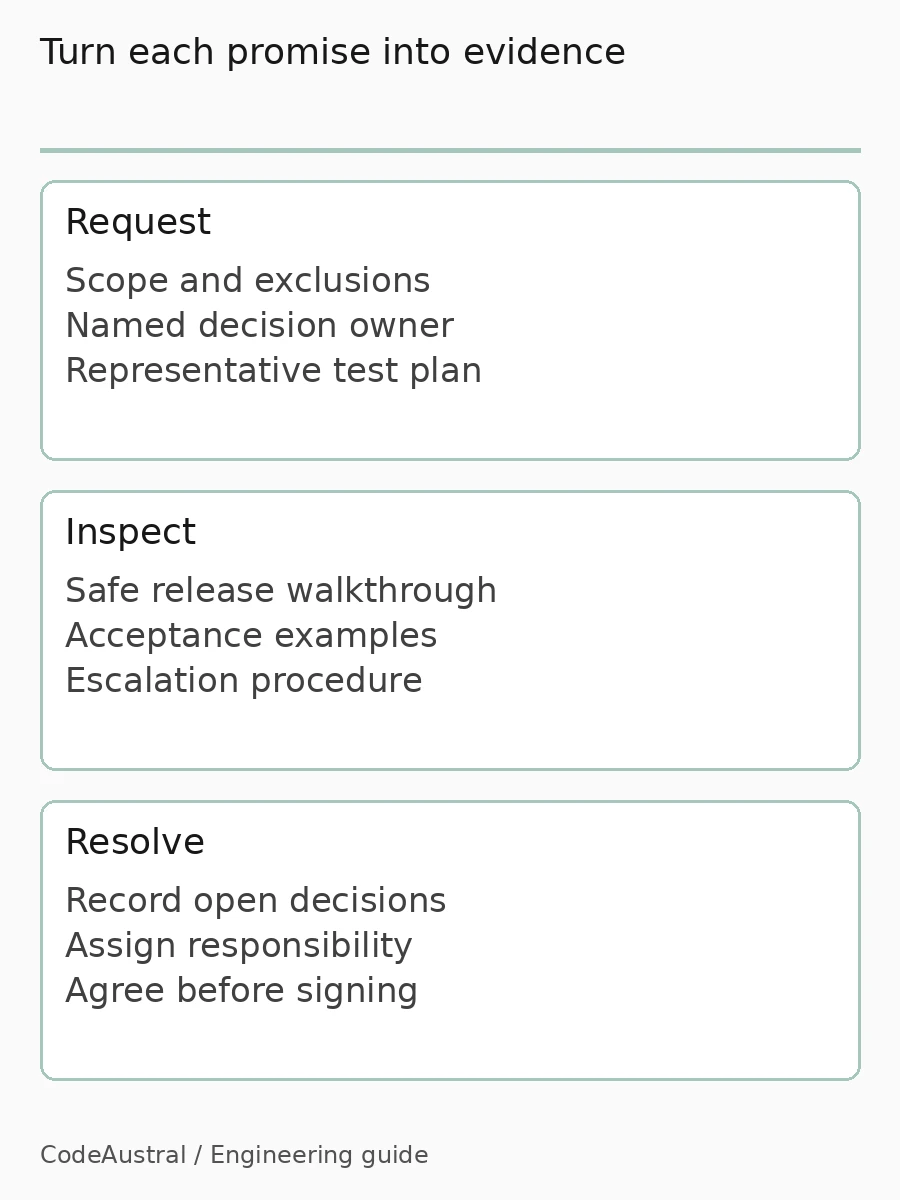
You can also run a small paid discovery phase. This is often a better test than asking for a large fixed bid immediately. A discovery phase can produce a technical plan, backlog, risk register, architecture notes, and release approach. More importantly, it shows how the vendor thinks.

What Good Looks Like

A reliable outsourcing partner does not eliminate uncertainty. They make uncertainty visible early.

They ask detailed questions. They challenge weak assumptions. They define delivery mechanics. They care about deployment. They build QA into the process. They communicate without being chased. They plan for maintenance before launch. They can explain what they will do, what they need from you, and where the project could go wrong.

That is the difference between outsourcing as labor supply and outsourcing as engineering partnership.

If you are evaluating software outsourcing options and want a team that can own delivery with clear engineering accountability, review CodeAustral’s software development services or start a direct conversation through contact.

If the note connects to your work

If the project needs a clearer technical read, send a brief.

Send a brief